
By Mina Cohn and Marilyn Sinclair
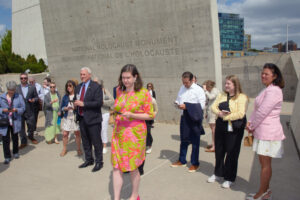
The National Holocaust Monument (NHM) IWalk App Launch Event, held on June 12th at the Canadian War Museum, was a resounding success. This launch marked the culmination of 2.5 years of dedicated effort, research, and collaboration between CHES, Liberation75, and the USC Shoah Foundation, resulting in a powerful digital educational resource. The IWalk App offers vital information on the Holocaust, Canada’s involvement, and the enduring role of memorials in addressing antisemitism and hate.
The IWalk App serves as an essential companion to the National Holocaust Monument (NHM), inviting users to interact with the physical space while listening to the voices of Holocaust survivors who made their lives in Canada. Through historical context and survivor testimony, the IWalk App guides participants through the legacy of antisemitism during the Holocaust, making clear its relevance in today’s world.
We were honoured by the presence of numerous dignitaries, including Ambassador of Italy Alessandro Cattaneo, representative from the Embassies of Germany and the United States, delegates from the office of Deborah Lyons, Special Envoy on Preserving Holocaust Remembrance and Combatting Antisemitism, Richard Marceau of the Centre for Israel and Jewish Affairs (CIJA), Adam Silver, president of the Jewish Federation of Ottawa, Betsabe Elena Chaires Wences, representative from the National Capital Commission (NCC), Councillor David Hill, local school board leaders, educators, and community leaders.
CHES Director Abigail Bimman, Correspondent for CTV National News, emceed the event. The afternoon was opened by CHES Chair Mina Cohn, who condemned the recent antisemitic graffiti that defaced the NHM. She issued a powerful call for a unified and constructive response from all levels of government.
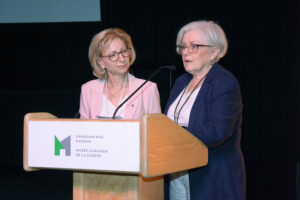
Both Mina and Marilyn Sinclair, Founder of Liberation75, reflected on the dedication and perseverance it took to develop the IWalk App. They extended heartfelt thanks to their co-collaborators at the USC Shoah Foundation and funders including the Government of Canada, Canadian Race Relations Foundation, and Maspik [Enough].
The audience was moved by video messages from Nate Leipciger, a 96-year-old survivor of Auschwitz, and Tova Clark, who spoke on behalf of the survivors featured in the IWalk App. Ms. Bimman read a message from Dov Goldstein, Managing Partner at Lord Cultural Resources, who led the NHM. His message underscored the IWalk App’s power in ensuring that the legacies and testimonies of survivors are preserved for future generations.
It was Tova Clark’s speech that ultimately brought the audience to its feet. A child survivor of the Holocaust, Tova shared her family’s journey from Nazi Germany to the Hongkew Ghetto in Shanghai in 1940. She emphasized the transformative impact of Holocaust education, speaking from her experience as part of the CHES Speakers’ Bureau. Tova passionately urged the younger generation to carry forward these stories and actively confront hatred, affirming that every story matters.
Betsabe Chaires Wences, Manager of Strategic Partnerships at the National Capital Commission, spoke of the IWalk App’s importance in providing visitors with a deeper, more personal understanding of the NHM’s significance.
Richard Marceau addressed the troubling rise in antisemitism across various sectors in Canadian society, reinforcing the role of Holocaust education as a key strategy in addressing this persistent threat.
Councillor David Hill (Ward 3, Barrhaven West), representing Mayor Mark Sutcliffe, strongly condemned the antisemitic graffiti on the NHM and related incidents in his own ward. He called for collective healing through action and education.
The event concluded with CHES Director Alyssa Novick providing a detailed walkthrough of how to download and use the IWalk App. Participants were then invited to experience the app firsthand during a guided walk to the NHM.
It was deeply moving to witness attendees using their devices to engage with the IWalk App onsite, absorbed in reading and listening to survivor testimonies, reflecting quietly, and sharing insights with one another.
CHES extends sincere thanks to the Canadian War Museum staff, the Ottawa Police Service, and all CHES members who contributed to making this event a success.
Tova Clark’s Speech
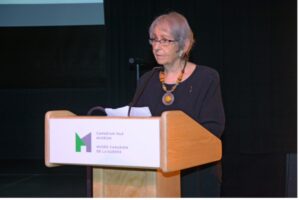
My name is Tova Clark, and I am a child survivor of the Holocaust. I was born in 1939 in Oppeln, Germany—now Opole, in Poland. I was just a baby when my parents, in an act of unimaginable bravery and desperation, secured rare permits to flee. In 1940, we escaped to Shanghai, a city under Japanese control, where we lived in one small room in the ghetto.
My mother never stopped speaking about that journey. From Berlin to Moscow by plane, across Siberia on a train, and finally into China, a place so unfamiliar that to her, it felt like going to the moon. They had lived a good life in Germany. And then it was gone.
My father, who once sold fine suit fabrics in Germany, survived in Shanghai by buying kimonos and obis and turning them into evening gowns for the American quarter. He managed. Somehow, he found dignity in survival.
One of my earliest memories is of American bombs falling around us after the U.S. declared war on Japan in 1941. I was just a child, but the fear never leaves you. Still, in the end we were safe and we survived.
We were the lucky ones. In 1942, while we were in Shanghai, the ghetto in my hometown of Oppeln was being liquidated. That is what they Nazis called it liquidated. That meant murdered. Erased.
This is why this new IWALK App for the National Holocaust Monument in Ottawa means so much. It stands for those who did not survive. It tells the stories that too many never got to tell. It reminds us that genocide is not just a page in a book, it is a scar on humanity. It is an outstanding new tool for educating visitors and students about the Holocaust and antisemitism.
Today, as a member of CHES speaker’s bureau, I often visit schools to share my family survival story, and I can attest first-hand of the value of education. I speak to schools, to students, to communities. I share my story because antisemitism is not over. It is rising again, loudly, shamelessly. And the voices of survivors are fading. We are growing old.
That’s why the work of preserving our survival stories—like the Ottawa Holocaust Survivors Testimony Project—is so vital. They have recorded us, captured our faces, our voices, our memories. Because Soon, it will be your turn to carry our testimonies, to teach your children, and to confront hatred when it rears its head.
Every story matters. My story challenges the idea that all was lost. My survival is proof that resistance, compassion—even in small forms, can make all the difference.
So, I ask you: don’t let our stories disappear. Visit the monument. Hear our voices through this new technology. Teach the truth. Fight the lies. Stand up when it’s hard. Because as I often say: we were silent once, and the world burned. We cannot be silent again.