
“Teaching and learning about the Holocaust is an essential opportunity to inspire critical thinking, societal awareness, and personal growth. Yet this massive topic can also pose challenges to educators due to its traumatic nature, broad expanse, and intersection with challenging human dynamics including racism and antisemitism.”
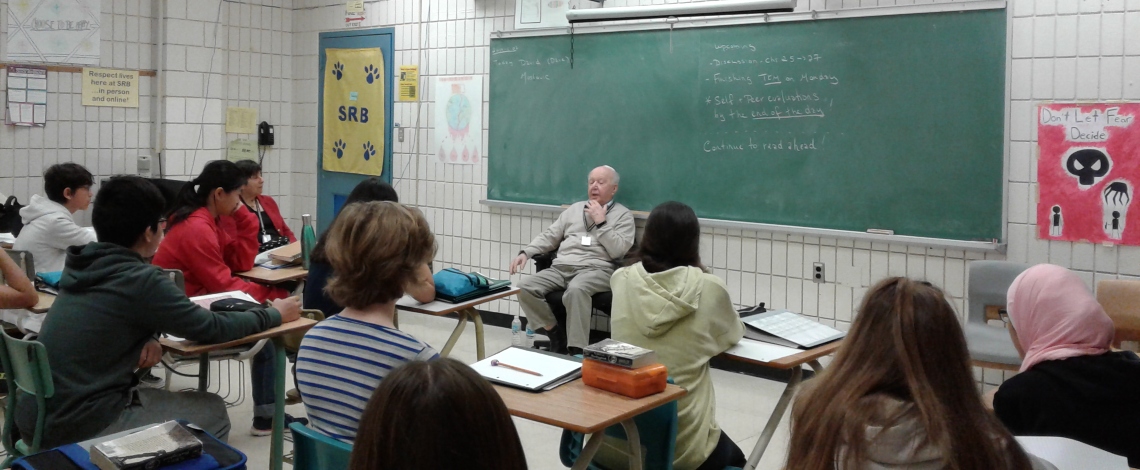
Curriculum to Classroom: Teaching the Holocaust in the New Grade 10 Curriculum Lesson Plans, Activities and Resources
Lesson Plans
Too Close to Home: Anti-Semitism & Fascism in Canada, 1930s & 1940s
This resource from the Vancouver Holocaust Education Centre highlights a troubling chapter in Canadian history, when Nazi ideology and antisemitism permeated the country’s cultural and political landscape and were reflected in its restrictive immigration policies. The materials that follow offer students and educators access to primary sources from Canada in the 1930s and 1940s, helping to explore issues such as antisemitism, Fascism, Nazism, and immigration during the Holocaust. These artifacts can deepen students’ engagement and understanding by showing how Canada’s present-day diversity and multicultural identity emerged from a more exclusionary past.
Get the Teacher’s Study Guide (pdf)
Activities
Why Study the Holocaust Worksheet
A worksheet designed to help students reflect on their existing knowledge of the Holocaust before beginning the unit. Teachers can use this activity to assess prior understanding, identify misconceptions, and tailor instruction to better meet students’ learning needs.
Terms and Definitions with Vocabulary Match Ups Worksheet
A list of key terms and definitions, accompanied by a worksheet that allows students to match each term with its correct definition. Teachers can use this resource to build foundational vocabulary, reinforce understanding, and support students in engaging more confidently with the unit’s content.
Survival Suitcase Activity Worksheet
When Jewish people were forcibly removed from their homes, they had only moments to gather what they could carry. This worksheet invites students to create their own “survival suitcase” and reflect on the items they would choose and why. Teachers can use this activity to help students develop empathy and a more personal understanding of the human impact of forced displacement during the Holocaust.
Chapters on Antisemitism in Germany
Chapter 3 examines the roots of antisemitism in Europe and how these ideas shaped the beliefs of Adolf Hitler. It explores the historical, social, and political factors that fueled his hatred, including conspiracy theories, racial ideology, and the conditions in Germany after World War I. Students will gain insight into how prejudice can be intensified and manipulated to influence an entire society. Chapter 4 focuses on the treatment of Jewish people in Nazi Germany before the outbreak of World War II. It outlines the laws, policies, and actions introduced by the Nazi Party to isolate and discriminate against Jews, including the Nuremberg Laws and violent events such as Kristallnacht. The chapter helps students understand how systematic discrimination escalated in the years leading up to the Holocaust.
Chapter 3: Why did Hitler Hate the Jews? (pdf)
Chapter 4: How did the Nazis Treat German Jews before the War (pdf)
Resources
Righteous Among the Nations
A list showing the number of individuals recognized as Righteous Among the Nations by country, as recorded by Yad Vashem. Teachers can use this resource to highlight stories of moral courage and resistance during the Holocaust, and to encourage students to reflect on how individual actions can make a meaningful difference in times of injustice.
References on the Shoah for Your Classroom
A curated list of resources for teachers to use in their units, including books, studies, and additional teaching materials. Teachers can use this list to support lesson planning, deepen their subject knowledge, and provide students with a wider range of reliable and engaging learning materials.
Escalation of Anti-Jewish Measures Worksheet
A list outlining anti-Jewish measures implemented between 1942 and 1945, highlighting the escalating restrictions, persecutions, and policies imposed during the final years of the Holocaust. Teachers can use this resource to help students understand how discrimination intensified over time and to analyze the step-by-step process that led to increasingly severe persecution.
Ted’s Story webinar was presented by Alyssa Novick as CHES’ contribution to the Liberation75’s Student Education Day (May 6, 2024).
Ted’s Story is based on primary documents provided by Heather Ingberg, Ted’s daughter, and on research conducted by Alyssa Novick of Ashbury College and CHES Chair Mina Cohn. It tells the true story of a seven-year-old boy who survived the Holocaust in hiding and arrived in Canada as part of the War Orphan’s Project. Through Ted’s Story, students learn about Canada’s refugee policy in the 1920’s, 1930’s, and about the Jewish orphans who were the first Holocaust survivors allowed into Canada after the Holocaust.
“#WeRemember: Learn from the Past to Protect the Future, January 27th, International Holocaust Remembrance Day”, prepared by Mina Cohn, Chair of CHES.
In 2005, The United Nations General Assembly designated January 27, the day Allied troops arrived at the gates of Auschwitz-Birkenau, as International Holocaust Remembrance Day (IHRD). The lesson plan is suitable for intermediate and high school students and helps them understand through a simple activity the meaning of this day. A day to honour the memory of the victims of the Holocaust, and the genocide of European Jews by Nazi Germany between 1941 and 1945.
January 17th: Raoul Wallenberg Day”, by Melany Chaiquin and Jaden Lairson, Woodroffe High School
Raoul Wallenberg was a Swedish diplomat who risked his life to save 100,000 Hungarian Jews during WWII. Following the war’s end many of the survivors he saved moved to Canada, where they began a new life. The Raoul Wallenberg Day lesson plan demonstrates that even in the darkest of times, light can be found in those who seek to do good. Wallenberg was arrested on January 17th, 1945 never to be seen again. In 2001, the Government of Canada designated January 17th, the date of his disappearance, as Raoul Wallenberg Day. While Wallenberg’s fate remains unknown, his actions are an inspiration to our efforts to combat racism, discrimination, and all forms of hate.
Get the lesson plan – January 17th: Raoul Wallenberg Day (pdf)
“The Holocaust, Grade 10 World History”, by Jaden Lairson, Woodroffe High School
The history of the Holocaust is studied in the context of European and global history. Learning about the Holocaust sensitizes young people to modern-day examples of prejudice and injustice. To teach this subject in a successful, sensitive, and meaningful manner it is important to know your students’ needs. This excellent lesson plan was developed and taught by Jaden Lairson, a recipient of the Arie van Mansum Award at Woodroffe High School.
Get the lesson plan – The Holocaust, Grade 10 World History (pdf)
Holocaust Reflection – Grade 10 Canadian History by Alyssa Novick, Ashbury College
At Ashbury College students spend 3 weeks (approximately 8 classes of 80 minutes) on the Holocaust unit as part of the Grade 10 Canadian History course. To put the unit into proper historical context we begin with the rise of Hitler and the situation in Germany post World War I. We then move on to cover the main issues such as moving from anti-Semitism as part of Nazi policy to legislation to violence to ghettos and finally to murder by bullets and gas; students also study resistance, rescue, and liberation.
Get the Lesson Plan – Holocaust Reflection by Alyssa Novick (PDF)
Example Gr 10 student assignment by Justin Ma, of Ashbury College (PDF)
A Webinar, “It’s Never Okay! Addressing Symbols that are Linked to Hatred and Discrimination” with Kenra Mroz (April, 2023)
The original lesson from May 2022 was designed for grade 10 students. It was adjusted to suit grades 7-9 and the subsequent webinar was presented as CHES’ contribution to the Liberation 75’s Student Education Day (April 18, 2023).
Canada, along with the rest of the world, is facing the growth of extremist hate groups, antisemitism, and racism, combined with misinformation and false news on social media. The result is an increasingly significant and negative impact on our younger students who often use Nazi symbols in and outside the school setting without comprehending what such symbols represent.
Due to lack of knowledge or relevant education, these symbols are often misappropriated on social media. To help educators ensure that young people are learning the correct message regarding incidents of hate, antisemitism, and discrimination, CHES created a special lesson plan which we are happy to share with you. “It’s Never Okay”, was developed by educator Kenra Mroz and is meant to educate students about the meaning of Nazi symbols that are linked to hatred, antisemitism and discrimination.
“For the Child – Exhibit” The Story of the Kindertransport
The For the Child exhibit provides a powerful current and relevant connection to today’s students by exploring the impact of what it means to be a refugee, an experience shared by some of our students.
This comprehensive and meaningful exhibit provides powerful and relevant connections to ongoing issues which today’s students will undoubtedly recognize, including the lived experience and impact of being a refugee, and the consequences of antisemitism, and discrimination.
“It’s Never Okay”, Lesson Plan by Kenra Mroz
Canada, along with the rest of the world, is facing the growth of extremist hate groups, antisemitism, and racism, combined with misinformation and false news on social media. The result is an increasingly significant and negative impact on our younger students who often use Nazi symbols in and outside the school setting without comprehending what such symbols represent.
Due to lack of knowledge or relevant education, these symbols are often misappropriated on social media. To help educators ensure that young people are learning the correct message regarding incidents of hate, antisemitism, and discrimination, CHES created a special lesson plan which we are happy to share with you. “It’s Never Okay”, was developed by educator Kenra Mroz and is meant to educate students about the meaning of Nazi symbols that are linked to hatred, antisemitism and discrimination.
“Testimonies of the Holocaust, Inspiring Change Through Legacy: In-depth Exploration of the Voices of Holocaust Survivors”, with Sophia Mirzayee and Kenra Mroz.
“Testimonies of the Holocaust, Inspiring Change Through Legacy: In-depth Exploration of the Voices of Holocaust Survivors” lesson plan focuses specifically on the stories and experiences of the Holocaust survivors who made Ottawa their home. It stimulates educators and students to learn about, reflect upon, and discuss why and how Holocaust history and legacy continue to form an integral part of understanding a variety of social justice and human rights issues today.
LESSON 1 – 3: A History of AntiSemitism in Images, The Voices of Holocaust Survivors, Building a Better Future.
The workshop is based on the testimonies of Ottawa-area Holocaust survivors recorded by CHES in 2016.
2018, November “Exploring the Complexities of Kristallnacht in Your Classroom”, with Facing History’s Leora Schaefer
2018 Holocaust Education Month (HEM) teachers workshop was “The 80th Anniversary of Kristallnacht: What Shards Remain?”. It explored the complexities of Kristallnacht in the classroom and was facilitated by Leora Schaefer, director of the Canadian program of Facing History and Ourselves.
Reading 1: The Night of the Pogrom
Reading 2: A Family Responds to Kristallnacht
Reading 3: Thoroughly Reprehensible Behavior
Reading 4: A Visitor’s Perspective on Kristallnacht
Reading 5: World Responses to Kristallnacht
Reading 6: Opportunism during Kristallnach