By Phil Emberley
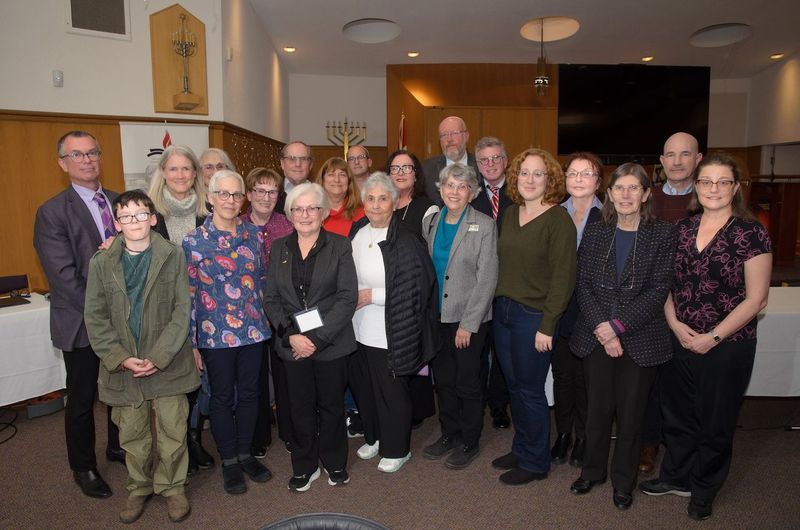
A key feature of HEM 2024 was CHES’ presentation on November 12th of Through Their Eyes- A Next Generation Perspective. The event was well attended, with dignitaries from the Embassies of Germany, Israel, and Austria, Holocaust survivors, their descendants, members of the Jewish community of Ottawa, and many other citizens from Ottawa. CHES director, Artur Wilcyznski, provided welcome comments and stressed the importance of Holocaust remembrance, especially considering current geopolitical events and troubling events occurring locally. The purpose of the evening was to acknowledge the need for the Second Generation to continue the efforts of their family members to relate their family stories about the Holocaust in an effort to thwart Holocaust denial and minimization.
CHES Chair, Mina Cohn, reinforced the fact that as the numbers of Holocaust survivors declines, it is the responsibility of the Second Generation to ensure their family stories are told as a tool to counter misinformation about the Holocaust and the rise of antisemitism in our community.
She noted that since its inception in 2015, CHES had made significant contributions to educating people about the Holocaust, especially using witness testimony and the recent launch of the IWalk initiative, a significant step in educating all Canadians about the Holocaust. (IWalk App National Holocaust Monument | Centre for Holocaust Education and Scholarship).
While proud of CHES’ accomplishments to date, CHES Chair, Mina Cohn, stressed that given the current environment, much remains to be done and added that TTE is a significant step forward in promoting Holocaust education and awareness.
In her speech, Tjorven Bellmann, Germany’s ambassador to Canada, stressed that her country, as the perpetrators of the Holocaust, has a special role in advancing Holocaust Education and never forgetting its horrific outcomes
Special Envoy Deborah Lyons spoke via video link about the importance of Holocaust Education. She noted that the dwindling number of Holocaust survivors means that it is vital that Second and Third Generations continue to relate their family stories so that memories of the Holocaust never die.
Kara Goodwin provided an overview of the TTE initiative, explaining how the project was developed and the process of supporting the Second Generation in developing their family stories. She acknowledged the courage of the participants and the impact of the loss of their families and culture.
A video montage provided highlights of videos filmed in October of several Second-Generation participants in TTE. The video is a testament to the devastating impact of the Holocaust on families and on the participants themselves. Repeatedly, as concerns are raised about Holocaust denial and minimization, the TTE participants are compelled to recount their family stories.
In delivering the keynote address, Professor Jan Grabowski provided insightful comments about the changing attitudes of Western academe with respect to Holocaust awareness. In particular, recent events in Poland and in Canada, fuelled by global efforts to address the prior history of colonization, have resulted in antipathy and hostility towards Holocaust remembrance. For example, the culpability of Poland and its role in the Holocaust is being vehemently rejected. Unfortunately, Canada is not immune to this rhetoric, despite its reputation as a safe space, built on judicious compromise. Most recently, events at the University of Ottawa underscore the growing hatred that is being directed at Jewish students and those who further Holocaust remembrance. Even in Germany, it is no longer taboo to question the Holocaust; if this can happen in Germany, he said, it can happen in Canada as well.
Although an obvious remedy to this situation is unclear, the witness testimony of survivors has always been a powerful tool to combat Holocaust denial. While technological efforts to preserve the memories of survivors is one option to ensuring that Holocaust memories are not forgotten, turning the focus to the Second and Third Generations is likely our most powerful tool to advance remembrance.
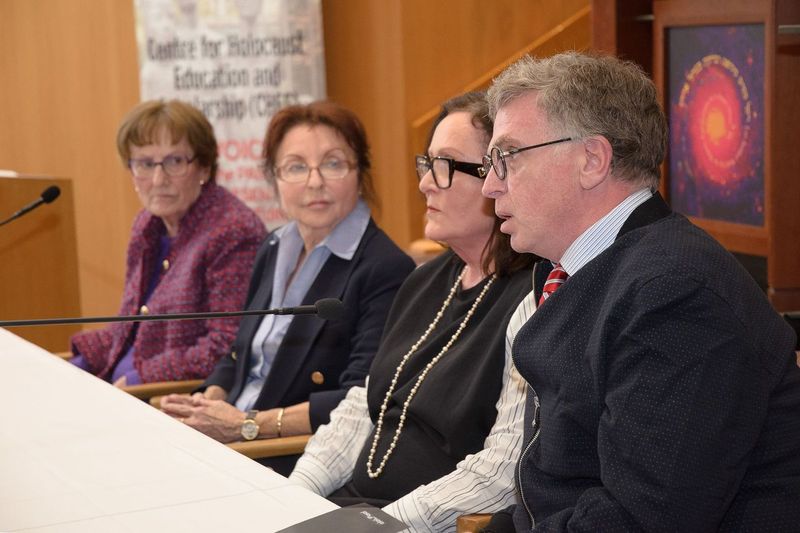
A panel of TTE participants – Sue Hurtubise, Agneta Gibson, Esther Schvan, and Phil Emberley – concluded the evening. Speaking of their families’ devastating experiences during the Holocaust and losses of family members, it was clear that there is strong motivation to keep the memories of the Holocaust alive by speaking from a Second Generation perspective. Common themes raised included the need to thwart Holocaust denial, which, due to the increasing popularity of social media, is becoming ever more widespread. With Holocaust minimization being more prevalent in younger generations, it is essential to tell our stories in a way that is both relevant and clearly identifies the human cost of the Holocaust to victims, survivors, and descendants. Given our present environment, speaking about the Holocaust requires courage, but at the same time the panel agreed that it has never been more necessary than today.
Phil Emberley is a CHES committee member and a TTE participant.